In the course “Dynamics of Individual Differences“, students write a blog post on a topic of their interest that is related to an aspect that differs between individuals and changes across the lifespan. Thao Nguyen shared her blog post with us, enjoy the read!
Imagine, you are on a first date with a guy. You both went to a restaurant, had a nice meal together, chatted for a bit. At the end of the date, however, you realized it wasn’t a match for you. So, after thanking him for the night out, you politely told him you don’t think there was a connection. All of a sudden, the nice guy you were having dinner with earlier turned aggressive, insisted you give him another chance, an explanation, and eventually insulted you for rejecting him: “You weren’t even pretty anyway”, “You’re a stuck-up person who’s never going to find a man like this”.
Does this sound familiar? Maybe it’s something you or a friend has experienced. Maybe you are the person on the other side, dissatisfied with how your date turned out after spending such a nice time together and thinking things were going to go somewhere. The disgruntled individual above is a common example of an “incel”—a type of man that has gained popularity recently for their controversial ideals and behaviors.
What is an “Incel”? Why Should We Care?
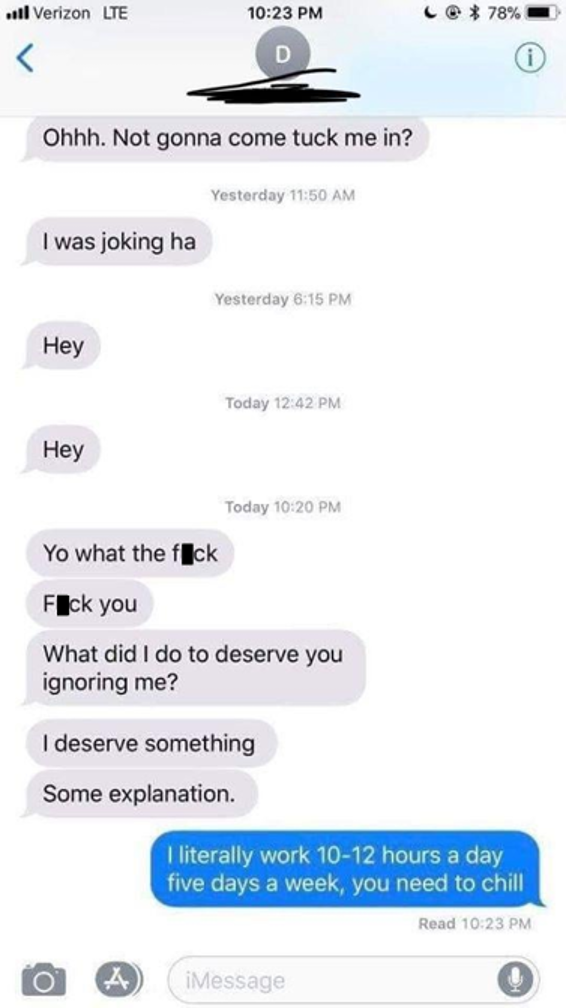
An incel, short for involuntary celibate, is a person, most often a man, who feels entitled to sexual attention from women and are disgruntled that they are not getting it. They believe the reason for their struggles is that they were placed at the bottom of the social hierarchy due to lookism—discrimination based on physical appearance. They believe women are behind this unfair placement and are the source of all their problems. Thus, incels hold a lot of anger and resentment towards women. In the date scenario above, for example, we can see showcased the entitlement (demanding for another chance), aggressiveness (insulting), and lookism ideals (“You weren’t even pretty anyway”) of an incel. Figure 1 and Figure 2 further illustrates incels’ entitlement towards female attention and their hostility when denied it. Notably, incels also often have a big online community that shares their frustration and grievances, and reinforces their ideologies.
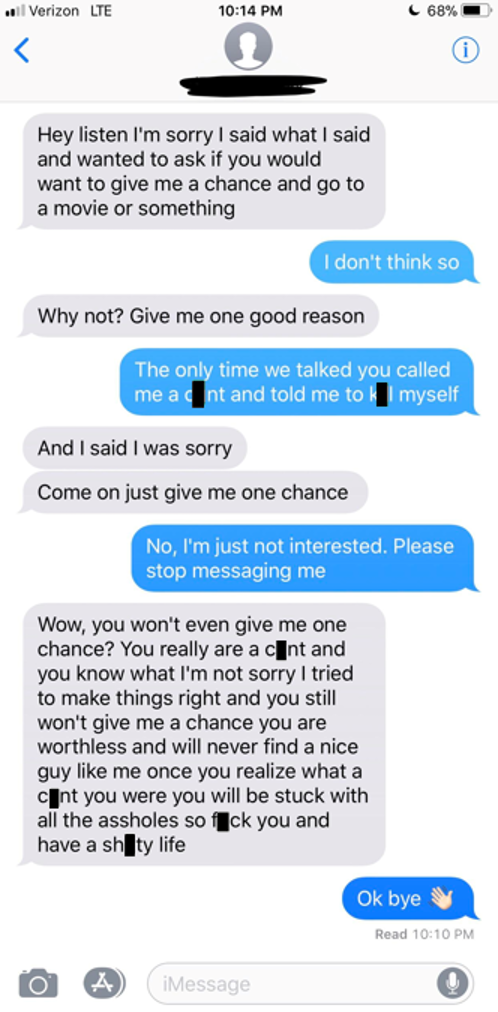
(BO5517, 2018)
Why does this matter? In recent years, there has been a growing number of cases of violence against, but not limited to, women carried out in the name of incel ideologies. Most famously, the shooting of Elliot Rodger killed six and injured 14 people in the United States (ABC News, 2014; see more: BBC, 2018; Rodger, 2014; Rosdahl, 2014), but violent attacks and homicidal cases also arose in Turkey, Canada, and Italy (Icinsel, 2024; Cecco, 2023; L’Unione Sarda, 2022; see more: Kelly et al., 2021). However, to say all incels are violent is wrong. Reports show that only a small percent of incels is prone to physical violence (Costello & Buss, 2023; Hoffman et al., 2020; Moskalenko, González, et al., 2022). In the context of everyday life, however, incels do pose a large threat of harassment, assault, stalking, and generally creating an unsafe environment for women. What is more, incels know their beliefs are looked down upon by society, so they try to hide it, making them more dangerous. These two factors combined create a pervasive problem that is hard to ignore, no matter what gender you identify with. Therefore, I want to discuss with you what factors might predict a person being an incel. As a woman, this might help you be more aware about the problem to avoid danger for yourself. As a man, it might be helpful to know if you yourself are described by incel behaviors, or if any of your friends might be.
The Person
All men are not created equal, and neither are incels. There are some personality traits commonly seen in incels, including shyness, having negative body images, a lack of social skills, loneliness, and suicidal ideation (Stijelja & Mishara, 2022; Zhang et al., 2014). In terms of psychological states, inceldom is often linked to depression, anxiety, paranoid thinking, and insecure attachment—they struggle with trust, intimacy, and emotional expression in their personal relationships (Ciocca et al., 2022; Fontanesi et al., 2024; Moskalenko, Kates, et al., 2022). There is also a lot of resentment present in an incel. They feel bitter in their lack of a romantic relationship and believe that the bad things happening to them are outside of their control, that they can’t do anything about it (Fontanesi et al., 2024).
The Geographic Environment
Maybe you did not expect this, but even the location of where you live can also predict if you might be an incel or not. A study by Brooks and colleagues (2022) looked at Tweets with incel content, and found that such Tweets often arise in areas that have high mating competition for men. This means in places where there are more men than women, fewer single women, higher income inequality, and a smaller gender gap in income, it is more likely that there are men who share incel ideologies.
The Life Events
Not just characteristics of the person themselves, many incels share common experiences in their lives that predispose them to being an incel. Many incels reported a history of childhood abuse or bullying (Anastasio, 2024; Moskalenko, Kates, et al., 2022). What is more, a lot of incels felt they were sexually and romantically inexperienced, that they were sexually “off-time” compared to their peers (Stijelja & Mishara, 2022). Especially in their adolescent years, incels often felt they were not living up to the masculinity norms of “being muscular”, “being hot”, and “getting a lot of girls” (Scaptura & Boyle, 2020; Utterback, 2024).
This gap between societal norm and real life is reminiscent of one’s failing to follow what psychologists call the master narrative (McLean & Syed, 2016). A master narrative is what society thinks one’s life should be like, what events should there be, and when should they happen. A personal narrative, in contrast, is what a person thinks their own life story is, why they think certain events happened, and how they personally relate to it. A person engages in meaning-making to make sense of events in their life and how they relate to their identity, to then incorporate into their personal narrative (McAdams & McLean, 2013). For an incel, they may feel that they failed to follow the master narrative—“getting girls”, so they try to cope with this gap through destructive meaning-making—believing they can’t “get girls” because “girls are inherently shallow and only like good-looking guys”. Consequently, they emerge with a new personal narrative, a narrative of an incel—“I don’t like girls, because although they should be giving me attention, they are not, because they only care about looks and muscles.”
Incels: Born and Made
Lastly, it is rarely the case that one becomes an incel in isolation. Incels often have a community of like-minded individuals who come together to share their grievances (Byerly, 2020; Mansour & Kidd, 2024). Such communities affirm and reinforce men’s negative sexual experiences with acknowledgement and approval, creating an echo-chamber of incel ideologies (Costello & Buss, 2023). Another element that makes incel communities such a black hole of misogyny is the “Us vs. Them” narrative that they promote, with “us” being the ostracized but enlightened group of incels who have realized the “true malicious nature of women”, while “them” are the fooled but privileged others who are being rewarded by the dating market (Wilén, 2024).
But it is not just the community that makes an incel, incels also choose themselves into their communities. The corresponsive principle in psychology describes how the person and the environment factors interact in shaping one’s personality: we choose or are chosen to be in the environment most fitting to our personality, and that environment also reinforces the personality traits that allowed us to join in the first place even more (Roberts & Wood, 2006). To illustrate, in the case of incels, their communities online reinforce their aggression towards women, like we discussed. But research found that men were often already using incel vocabularies and harboring anger and extremist tendencies even before joining incel communities (Lahnala et al., 2025; de Roos et al., 2025). This supports the claim that incels likely selected or were selected into incel communities because such communities suited their personality. Aiolfi and colleagues (2024) explored this interaction more, theorizing that incel communities likely attract people who are already prone to violence, to then give their frustration a form (through gendered violence and harassment) and a narrative (because women’s cruel nature made you sexually undesirable) that justify their aggression towards women. In other words, although a man might not have been spiteful towards women before and was only frustrated with his negative sexual experiences, joining an incel communities can exacerbate his resentful and aggressive tendencies, to eventually make him a hateful and violent incel.
“So What do I do With This Information?”
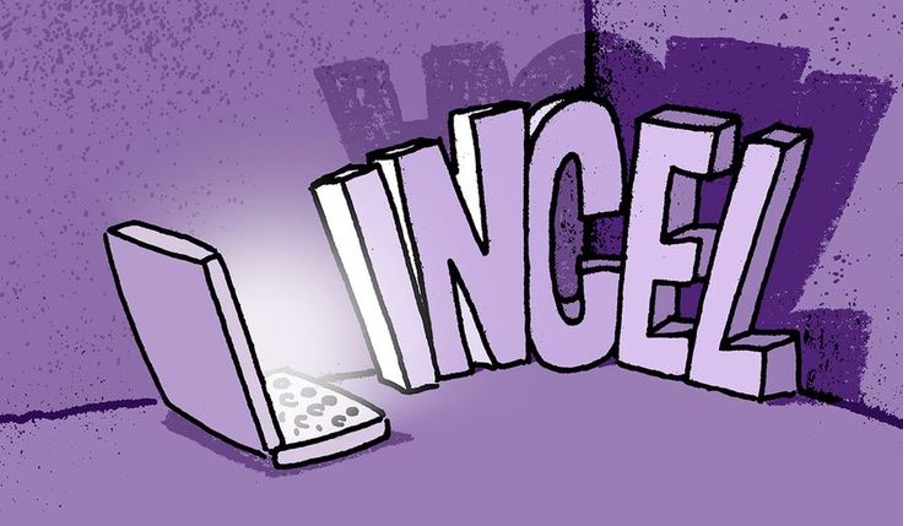
Hopefully through the information I have shared, you now have a deeper insight into what can create an incel. If you are a woman, maybe this can help you foresee who around you might become an incel, to avoid or even intervene and help them if you can. If you are a man who sees yourself in the traits described, don’t worry, it doesn’t mean you are necessarily a violent or bad person. You can consider taking some time to self-reflect and learn to control your emotions, which can help defuse your aggression. It might also be helpful to explore the negative effects of masculinity and lookism ideals, to then deconstruct them and build a healthier worldview (Aiolfi et al., 2024). Working with a professional to develop social skills, a higher self-esteem, and positive sex education can also be beneficial. It is important to keep in mind that, even if you are an incel, not all incels are violent and vengeful people. Often, they just need some help and do not know where to get the support they require.
To sum up, in this blog post we have discussed how the personality traits of a person, their environment, and the events in their life can predispose someone to being an incel. Most critically, it is not just the communities that make an incel, it is also an incel that chooses their communities—there is an interaction between person and environmental factors that makes predicting inceldom complicated and dynamic. It is to be noted, however, that the phenomena of incels is still an emerging field of research, with many questions left unanswered. In future posts, would you want me to dive more into how harmful incels actually are? Do you want to know more about how you can help yourself or a friend who you think might be falling into the incel echo-chamber? Let me know what you think and if you have any suggestions!
Author: Thao Nguyen
References
Abbybunch. (2022, March 15). Our local nice guy is at it again (same guy, all different girls) [Screenshot]. Reddit. https://www.reddit.com/r/niceguys/comments/terux8/our_local_nice_guy_is_at_it_again_same_guy_all/
ABC News. (2014, May 26). Isla Vista massacre: 7 killed, 13 injured. Eyewitness News.
https://abc7.com/post/isla-vista-massacre-7-killed-13-injured/76145/
Aiolfi, I., Palena, N., Ó Ciardha, C., & Caso, L. (2024). The incel phenomenon: A systematic scoping review. Current Psychology, 43(32), 26264-26278. https://doi.org/10.1007/s12144-024-06236-6
Anastasio, N. (2024). Exploring the Manosphere: Incel Proclivity to Violence and Evolution in the Discourse [Doctoral dissertation]. https://www.proquest.com/docview/2920376267?%20Theses&fromopenview=true&pq-origsite=gscholar&sourcetype=Dissertations%20
BBC. (2018, April 26). Elliot Rodger: How misogynist killer became ‘incel hero’.
https://bbc.com/news/world-us-canada-43892189
BO5517. (2018, April 28). NiceGuy back for round 2 [Screenshot]. Reddit. https://www.reddit.com/r/niceguys/comments/8fgxpd/niceguy_back_for_round_2/
Brooks, R. C., Russo-Batterham, D., & Blake, K. R. (2022). Incel activity on social media linked to local mating ecology. Psychological Science, 33(2), 249-258. https://doi.org/10.1177/09567976211036065
Byerly, C. M. (2020). Incels online reframing sexual violence. The Communication Review, 23(4), 290-308. https://doi.org/10.1080/10714421.2020.1829305
Cecco, L. (2023, November 28). Canadian man sentenced to life in prison for ‘incel’-motivated murder. The Guardian.
https://www.theguardian.com/world/2023/nov/28/toronto-man-sentenced-life-terrorism
Ciocca, G., Martinelli, J., Limoncin, E., Sansone, A., Jannini, E. A., & Fontanesi, L. (2022). Psychopathology of incel (Involuntary celibate): The predictive role of depression, paranoia, and fearful attachment style. The Journal of Sexual Medicine, 19(Supplement_4), S39-S39. https://doi.org/10.1016/j.jsxm.2022.08.021
Costello, W., & Buss, D. M. (2023). Why isn’t there more incel violence? Adaptive Human Behavior and Physiology, 9(3), 252-259. https://doi.org/10.1007/s40750-023-00220-3
De Roos, M. S., Veldhuizen-Ochodničanová, L., & Hanna, A. (2024). The angry echo chamber: A study of extremist and emotional language changes in incel communities over time. Journal of Interpersonal Violence, 39(21-22), 4573-4597. https://doi.org/10.1177/08862605241239451
Fontanesi, L., Marchetti, D., Cosi, G., Limoncin, E., Jannini, E. A., Verrocchio, M. C., & Ciocca, G. (2024). What does it take to make an incel: The role of paranoid thinking, depression, anxiety, and attachment patterns. Depression and Anxiety, 2024(1). https://doi.org/10.1155/2024/5512878
Hoffman, B., Ware, J., & Shapiro, E. (2020). Assessing the threat of incel violence. Studies in Conflict & Terrorism, 43(7), 565-587. https://doi.org/10.1080/1057610x.2020.1751459
Icinsel, D. (2024, October 24). A horrifying double femicide in Turkey, the hundreds before and why you should care. The Tufts Daily.
https://www.tuftsdaily.com/article/2024/10/a-horrifying-double-femicide-in-turkey-the-hundreds-before-and-why-you-should-care#
Kelly, M., DiBranco, A., & DeCook, J. E. (2021, February 18). Misogynist Incels and Male Supremacism: Mass Violence and Terrorism since Santa Barbara. New America, p. 9.
https://www.newamerica.org/political-reform/reports/misogynist-incels-and-male-supremacism/mass-violence-and-terrorism-since-santa-barbara/
Lahnala, A., Varadarajan, V., Flek, L., Schwartz, H. A., & Boyd, R. L. (2025). Unifying the extremes: Developing a unified model for detecting and predicting extremist traits and radicalization. Proceedings of the International AAAI Conference on Web and Social Media, 19, 1051-1067. https://doi.org/10.1609/icwsm.v19i1.35860
L’Unione Sarda. (2022, June 7). Boyfriends killed “because they were beautiful and happy”, life imprisonment for Antonio De Marco.
https://www.unionesarda.it/en/italy/boyfriends-killed-quot-because-they-were-beautiful-and-happyquot-life-imprisonment-for-antonio-de-marco-qnmzedns
Mansour, I., & Kidd, N. (2024). How virtual relationality enables the incel collective, its narrative and violence. Global Security: Health, Science and Policy, 9(1). https://doi.org/10.1080/23779497.2024.2390370
McAdams, D. P., & McLean, K. C. (2013). Narrative identity. Current Directions in Psychological Science, 22(3), 233-238. https://doi.org/10.1177/0963721413475622
McLean, K. C., & Syed, M. (2016). Personal, master, and alternative narratives: An integrative framework for understanding identity development in context. Human Development, 58(6), 318-349. https://doi.org/10.1159/000445817
Moskalenko, S., González, J. F., Kates, N., & Morton, J. (2022). Incel ideology, radicalization and mental health. The Journal of Intelligence, Conflict, and Warfare, 4(3), 1-29. https://doi.org/10.21810/jicw.v4i3.3817
Moskalenko, S., Kates, N., Fernández-Garayzábal González, J., & Bloom, M. (2022). Predictors of Radical Intentions among Incels: A Survey of 54 Self-identified Incels. Journal of Online Trust and Safety, 1(3). https://doi.org/10.54501/jots.v1i3.57
Roberts, B. W., & Wood, D. (n.d.). Personality development in the context of the Neo-socioanalytic model of personality. Handbook of Personality Development. https://doi.org/10.4324/9781315805610.ch2
Rosdahl, J. (2014, May 27). Elliot Rodger: when sexual rejection turns deadly. The Conversation. https://doi.org/10.64628/AA.4htasaqvt
Scaptura, M. N., & Boyle, K. M. (2020). Masculinity threat, “Incel” traits, and violent fantasies among heterosexual men in the United States. Feminist Criminology, 15(3), 278-298. https://doi.org/10.1177/1557085119896415
Stijelja, S., & Mishara, B. L. (2022). Psychosocial characteristics of involuntary celibates (Incels): A review of empirical research and assessment of the potential implications of research on adult virginity and late sexual onset. Sexuality & Culture, 27, 715–734. https://doi.org/10.31234/osf.io/9mutg
Utterback, L. (2024). Life-course theory and incels: Masculinity strain in the transition to adulthood. Sexuality & Culture, 28(4), 1-15. https://doi.org/10.1007/s12119-024-10201-7
Wilén, E. J. (2024). Incel epistemology: On marginality, experience and legitimization of knowledge. YOUNG, 33(5), 459-475. https://doi.org/10.1177/11033088241295873
Zhang, J., Mollandsøy, A. B., Nornes, C., Erevik, E. K., & Pallesen, S. (2024). Predicting hostility towards women: Incel‐related factors in a general sample of men. Scandinavian Journal of Psychology, 66(1), 35-46. https://doi.org/10.1111/sjop.13062
Curious to learn more about what our students work on? Take a look at our other blog posts here.
Be First to Comment